


Family disagreements about an aging parent’s care are more common than many caregivers realize. One sibling may see growing safety concerns, while another sees a parent determined to remain independent. These conflicts often involve more than care decisions alone — they can reflect different experiences, responsibilities, fears, and family dynamics. Experts say that while families may not always agree, learning how to communicate through disagreement can help them navigate changing care needs and make difficult decisions together.
A Place for Mom shares these tips on how to find common ground.
Key Takeaways
- Family disagreements about senior care are common, with nearly 3 in 10 caregivers reporting conflict over the best care options.
- Different perspectives often reflect different experiences, responsibilities, and relationships — not a lack of love or concern.
- Families make the most progress when they focus on understanding one another rather than trying to achieve perfect agreement.
- Care needs change over time, so strong communication skills are often more valuable than finding a single "right" solution.
Why families disagree about senior care
When an aging parent begins needing more help, families often assume the hardest part will be deciding what kind of care is needed. But for many people, the more difficult challenge is navigating the emotions, disagreements, and family dynamics that emerge along the way.
In the Spring 2025 Senior Care Search Trends Survey, a survey of family caregivers commissioned by A Place for Mom, 28% of caregivers say their families disagree about what care options are best, and another 33% say that conversations about alternative care options are among the most difficult aspects of caregiving and planning.

A Place for Mom
Those disagreements can take many forms. One adult child may notice new dents on the car and worry that their parent should stop driving. Another may insist that things aren’t that serious yet. Their parent may refuse to discuss it at all.
Those numbers don’t surprise mediator and conflict coach Katharina W. Dress, M.A., who works with families navigating these disagreements every day in her family mediation business, Aging in Harmony.
“In my experience, the families that go through this process smoothly are the exceptions,” she says.
Dress, who specializes in mediation and facilitates family conversations around aging and caregiving, says family conflict during caregiving is rarely just about assisted living, home care, or finances. Instead, disagreements often involve long-standing family roles, grief, guilt, fear, and different beliefs about independence, safety, and responsibility.
But Dress sees conflict as potentially very productive.
“Conflict is an opportunity for learning and growing,” she says. “Its function is to produce something better.”
Why senior care decisions become emotionally charged
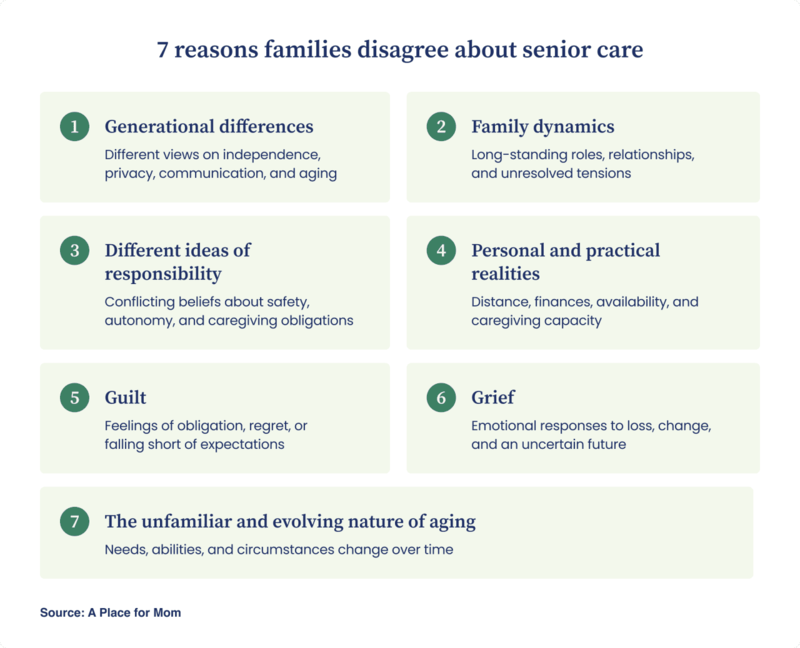
In Dress’ experience, several overlapping factors complicate agreement among family members, including generational differences, the unfamiliar realities of aging, family dynamics, differing ideas of responsibility, and practical caregiving realities.
Core to each of these is the reality that no one sees or experiences a situation in exactly the same way.
“We’re dealing with different people, and it’s normal for different people to have different perspectives,” Dress says.
She compares this dynamic to people standing on opposite sides of a sculpture. One person sees curves and bright colors. Another sees sharp edges and darker tones.
“That doesn’t mean the person on the other side is lying,” Dress says. “That’s what they are seeing.”
A Place for Mom
Generational differences
From the Silent Generation to baby boomers to Generation X, attitudes and ideas about independence, privacy, conflict, and communication vary widely.
“The Silent Generation values independence and privacy immensely,” Dress says. “But their children, the baby boomers, want to talk about things. They think things will get better by talking them out. Adult children don’t understand where the parents are coming from, and the parents don’t understand where the adult children are coming from.”
Erin Martinez, Ph.D., CFLE, an associate professor of gerontology at Kansas State University who works with families navigating aging-related transitions, says the generational disconnect often extends beyond communication styles.
“Older generations often carry a strong ethic around self-sufficiency,” Martinez explains. “Asking for help can feel like a personal failure, not just an inconvenience.”
Meanwhile, she says, many adult children grew up in a culture that more openly embraces outside support, whether through professional services, community resources, or conversations about personal challenges.
“Neither is wrong,” Martinez says. “They’re just operating from very different frameworks about what it means to be a capable adult.”
Aging: An unknown and moving target
“The problem with aging is that we don’t know what it’s like until we get there,” says Dress. “So, younger family members — adult children, grandchildren, and so on — they don’t understand what their parents are going through.”
Martinez points out that adult children often focus on practical issues while overlooking the emotional realities of aging.
"One of the most common misunderstandings I see is that families treat aging like a problem to be solved rather than an experience being lived," she says.
Adult children may be focused on safety concerns, driving ability, medications, or household management. But older adults may be grappling with changes to their identity, independence, social connections, and sense of purpose.
“When we’re too quick to fix the issue and focus only on logistics, we completely miss the emotional side of these changes,” Martinez says. “That’s where breakdowns in communication and frustration often begin.”
And there’s the matter of change over time.
“Families come to me with one set of problems and we work through those. But they often come back in two years with a new set,” she says.
Martinez notes that many families underestimate how quickly concerns can evolve.
“A family might spend years quietly watching an aging parent, reassured that things seem manageable,” she says.
Early conversations may center on driving or keeping up with household tasks. But after a fall, hospitalization, or new diagnosis, discussions often shift toward in-home care, relocation, or who will take responsibility for care decisions.
“The challenge is that families often haven’t talked through any of this in advance,” Martinez says. “They’re making high-stakes decisions under stress, sometimes for the first time.”
Family dynamics
Aging changes family relationships in ways many people aren’t prepared for, according to Dress. Family caregiving often reveals that the original family roles are still very much present. For instance, “the parent wants to be the parent until the last breath,” she says. “They want to be the ones making decisions and they want to take care of their children.”
Also, sibling roles established decades earlier are still in force. One sibling may have been an organizer and decision-maker. Another may have avoided conflict or disengaged. Another may have felt unheard or overlooked. Those dynamics don’t necessarily change over time. And they can intensify, Dress says, when parents assign powers of attorney or decision-making responsibilities unevenly.
“For example, the oldest child may think they should be in charge,” she says.
But if the parent appointed the middle child as their power of attorney, that upset to the historical order may cause conflict.
Finally, caregiving decisions can force families to confront unresolved issues that existed long before anyone needed care.
“Nobody can push our buttons better than family members,” Dress says, “because family members are the ones who installed them.”
Different ideas of responsibility
According to A Place for Mom's research, 55% of family caregivers say their senior loved one is resistant to receiving professional care. Another 40% say a major concern about senior living is that their loved one doesn't want to move or prefers to stay home.
When an elderly parent resists professional care, siblings may be of different minds about how, or whether, to engage. Some relatives may believe a parent’s wishes should be respected at all costs. Others may believe safety concerns require more intervention.
According to Dress, these disagreements are often rooted in different interpretations of what responsibility looks like.
“One half says, ‘Mom and Dad aren’t incompetent, and if they say they’re okay, we should respect that,’” Dress says. “The other half says, ‘They have mild cognitive impairment, and it’s our responsibility now to respectfully support them, even if they don’t think they need it.’”
Personal and practical realities
Geographic distance, finances, personal history, and caregiving capacity all influence how family members experience the reality of aging parents. Often, the adult child who lives closest to the parent becomes the default caregiver. That person may handle doctor appointments, grocery shopping, medication management, or emergencies.
“The local child sometimes feels stuck with taking care of Mom or Dad,” Dress says.
Martinez says unequal caregiving responsibilities are one of the most common sources of family tension.
“When siblings live in different places, the one who’s geographically closest often ends up carrying a disproportionate share of the day-to-day caregiving,” she says.
That imbalance can become especially difficult when caregivers are also managing jobs, children, finances, and their own health concerns.
“The practical load doesn’t always distribute evenly,” Martinez says, “and that inequity, more than anything, tends to fracture family relationships over time.”
At the same time, long-distance siblings may have a different perspective about what’s needed. Dress points out that both perspectives can be valid.
“If you’re around somebody every day or see them every week, you see different things than if you just visit once or twice a year,” she explains.
Dress says conflict becomes more productive when families stop treating disagreements as proof that someone is wrong. Instead, families can begin recognizing that each person may be responding to different fears, experiences, and responsibilities.
Caregiving disagreements often feel bigger than the practical decisions themselves because they touch deeply emotional experiences. Guilt and grief, for example, are common factors.
Guilt
Some adult children feel guilty because they live far away or can’t contribute as much time. Others may feel conflicted because their relationship with a parent has always been strained.
That guilt can influence caregiving decisions in unexpected ways. One family member may push themselves beyond their limits because they feel obligated to do more. Another may avoid conversations about care altogether because they feel ashamed of how little they’re able to help. Family disagreements can sometimes reflect competing feelings of responsibility rather than differences in how much people care.
“Sometimes adult children aren’t motivated, but they feel they should be,” Dress says.
Grief
“Grief doesn’t start when somebody dies,” Dress says. “Grief starts as soon as you start realizing that you’re going to lose somebody.”
Caregiving often involves a series of losses that occur long before the end of life. Adult children may be coming to terms with changes in a parent’s health, independence, memory, or personality. Parents may be grieving the loss of abilities, routines, or roles that once defined them.
Grief over those losses may show up as fear, frustration, anger, denial, or avoidance. Even families that are close and loving can struggle under the emotional pressure of caregiving.
“Family relationships are difficult,” Dress says. “The idea that just because it’s family, it should be easy … I think that’s a myth.”
What can help families find common ground?
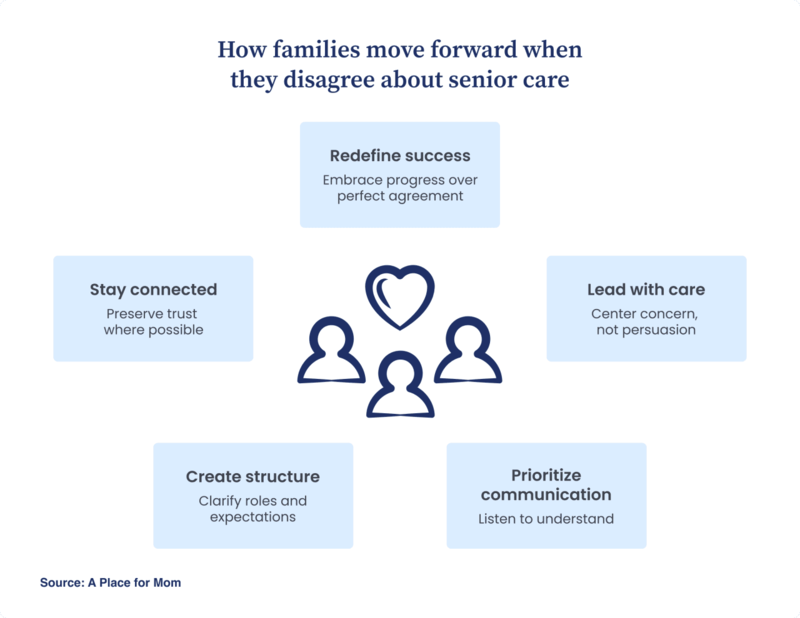
The emotions behind caregiving disagreements can be complex, but conflict itself isn’t necessarily a sign that a family is failing. According to Dress and Martinez, families often find common ground not by eliminating disagreement but by learning how to navigate it. The following strategies can help make conversations more productive and decision-making more manageable.
A Place for Mom
Redefine success in caregiving conversations
Many families assume success means reaching complete agreement about what should happen next. But experts say families often make the most progress when they focus less on winning an argument and more on understanding one another’s concerns.
“Oftentimes, people come into mediation with the idea that resolutions or decisions define success,” Dress says. “But it’s much more important for people to learn to talk to each other and listen to each other and understand each other.”
While some families eventually reach consensus, Martinez says agreement itself isn’t what distinguishes successful conversations.
“Agreement on every decision isn’t the goal,” she says. “A shared commitment to the parents’ well-being, expressed through clear and honest communication, is what actually moves things forward.”
Dress endorses a similar view: Success isn’t defined by whether everyone chooses the same solution. Instead, it’s about whether family members learn to listen to one another, understand different perspectives, and continue working together as circumstances change.
Strengthen communication and mutual understanding
Dress believes conflict becomes more productive when family members move beyond fixed positions, or what each person wants to happen, and instead explore the needs, fears, and experiences driving those views.
“People’s positions are just their personal strategies to meet their feelings and needs,” she explains.
That shift often requires family members to spend less time defending their own viewpoints and more time trying to understand others’. Asking questions, listening without interrupting, and acknowledging another person’s concerns can help family members uncover the motivations behind a disagreement. What appears to be disagreement about a parent’s living situation, for example, may actually reflect concerns about safety, independence, finances, or caregiving capacity.
Lead with care, not persuasion
Dress encourages adult children to frame their concerns for their aging parents through personal feelings rather than trying to convince them they can no longer manage independently.
For example, instead of saying, “You shouldn’t be driving anymore,” an adult child might say, “When I notice another dent in your car, I feel scared because I care about your safety. I spend sleepless nights worrying about it.”
That approach allows parents to respond to their child’s concern without necessarily feeling forced to admit weakness or incapacity. In this example, agreeing not to drive at night is “a gift they give to their children,” Dress says.
Take a similar approach when talking with siblings and other family members. Rather than arguing for a specific outcome, such as “Dad needs to be in assisted living,” explain the need or concern behind your position. Saying “I’m worried about Dad’s safety after his recent falls” invites a conversation about safety, whereas proposing a solution may invite a simple “yes” or “no” response.
Preserve trust during disagreement
While disagreements can feel personal, Dress encourages families to remember that different perspectives don’t necessarily reflect bad intentions.
Family members may be responding to different experiences, responsibilities, fears, and priorities. That doesn’t mean anyone is wrong or acting out of a lack of concern.
“When people really care about each other, the conflict is just a bump in the road,” she says.
Trust can be easier to maintain when family members assume good intentions, follow through on commitments, and avoid treating disagreements as evidence that someone doesn’t care.
This can be especially important because conversations about caregiving may go on for many years.
But Dress has also worked with people who say, “We just have to get through this. After Mom or Dad are dead, I don’t care if I never talk to my brother or sister again.”
In her experience, that mindset can make conflict harder to navigate because it shifts the focus away from solving problems and toward winning arguments. Even when families don’t agree, preserving enough trust to continue working together can make future decisions easier.
Create structure around caregiving decisions
Many caregiving resources assume family members have strong relationships and a shared desire to work together. But not every family starts from that place. Some siblings have longstanding tensions. Others rarely communicate except during emergencies. In some cases, family members may disagree about senior care because they’ve spent years disagreeing about other things.
While close relationships can make conflict easier to navigate, Martinez says families don’t necessarily need to repair decades of family history before making caregiving decisions.
“For families without a strong emotional foundation, I’d shift the initial focus away from the relationship entirely,” she says.
Instead, she recommends creating structure. Clarifying who communicates with physicians, who manages finances, and how information will be shared can reduce confusion and prevent misunderstandings. When expectations and responsibilities are clearly defined, families may be able to function effectively even if personal relationships remain complicated.
“It’s not about repairing the family dynamic,” Martinez says. “It’s about creating a workable system that doesn’t require everyone to like each other to function.”
When it’s time to bring in outside support
Many families wait until a disagreement reaches a breaking point before seeking help. But Dress encourages families to involve outside support long before conflict becomes deeply entrenched.
“Get outside help,” she urges. “This is a bigger job than we can do ourselves sometimes.”
According to Dress, waiting can make disagreements more difficult to resolve. As misunderstandings accumulate and frustrations grow, family members may become more defensive and less willing to trust one another.
“The longer conflict goes on and festers, the more trust gets undermined,” Dress cautions.
That help could come from a mediator, therapist, social worker, geriatric care manager, physician, or another trusted professional. In A Place for Mom’s 2025 Senior Care Search Trends Survey research, 66% of caregivers agree that a third-party advisory service can provide unbiased and expert opinions when families disagree. Bringing in an outside perspective early can help families communicate more clearly, reduce misunderstandings, and create space for everyone’s concerns to be heard before positions harden and relationships become strained.
In Dress’ experience, as boomers become “seniors,” they increasingly initiate these conversations themselves. “I want you to facilitate a family meeting about my future,” some clients tell her.
Those conversations can help families clarify expectations, discuss future wishes, identify potential disagreements early, and create a shared understanding before a crisis forces difficult decisions.
The conversations families may regret avoiding
Dress says many people eventually regret waiting too long to address difficult conversations.
“People have regrets about not seeing a mediator or another professional sooner,” she says.
Some regret not asking for help earlier. Others regret unresolved tension with parents or siblings after a loved one dies.
“That’s one reason to deal with these conflicts while the parents are still alive,” Dress says. “So, you don’t have regrets later when you can’t make up with your parents anymore.”
Families may never handle every conversation perfectly. They may not always agree. But many can still find ways to move forward together. And according to Dress, that doesn’t mean conflict has failed. Sometimes, it means families are finally confronting the difficult realities they’ve been avoiding and learning how to navigate them together.
For families in the middle of caregiving conflict, Dress encourages compassion for each other and for themselves.
“Recognize that you can only do what you can do,” she says.
Why some families wait until there’s a crisis
Many families sense changes long before they begin seriously discussing care. A parent may start falling more often, forgetting appointments, struggling to manage medications, or showing signs of cognitive decline. But, Dress says, "many people don't start dealing with these things until there's a crisis."
That crisis might be hospitalization, a fall, a dementia diagnosis, or a sudden health event that makes living independently unsafe. Unfortunately, she says, “that’s the worst possible time to have rational conversations with each other.”
Stress, urgency, fear, and exhaustion can narrow options quickly. Family members who already disagree may become more defensive or emotionally reactive. The parents may also feel frightened, overwhelmed, or angry about losing their independence.
FAQs
How do you start a conversation about senior care when family members avoid the topic?
Focus on a recent concern or observation rather than a major decision. Starting with one specific issue can feel less overwhelming than discussing long-term care all at once.
How do you handle disagreements when one sibling is doing most of the caregiving?
Unequal caregiving responsibilities can create stress and resentment. Open conversations about expectations, limitations, and available support can help families share responsibilities more effectively.
Can family conflict affect an aging parent's well-being?
Yes. Ongoing conflict can create stress for both older adults and caregivers, making it harder to make decisions and work together on care plans.
What does a family mediator do in caregiving situations?
A mediator helps families communicate more effectively, understand different perspectives, and work toward solutions without taking sides or making decisions for them.
How can families support a parent who refuses help?
Experts often recommend focusing on concerns and feelings rather than ultimatums. Respectful conversations may be more effective than trying to force agreement.
This story was produced by A Place for Mom and reviewed and distributed by Stacker.