

Forty years ago today, Americans were stunned, shocked and saddened when the Challenger space shuttle exploded 73 seconds after liftoff on a cold, cloudless day in Florida.
A booster leak ignited the main liquid fuel tank on Jan. 28, 1986, and the Challenger exploded and broke apart in the sky, falling into the Atlantic Ocean off Cape Canaveral and killing all seven astronauts. The cold weather weakened the O-ring seals in Challenger’s right solid rocket booster, an investigation later revealed.
“Flight controllers here are looking very carefully at the situation,” NASA television commentator Steve Nesbitt said on the air at the time. “Obviously a major malfunction.”
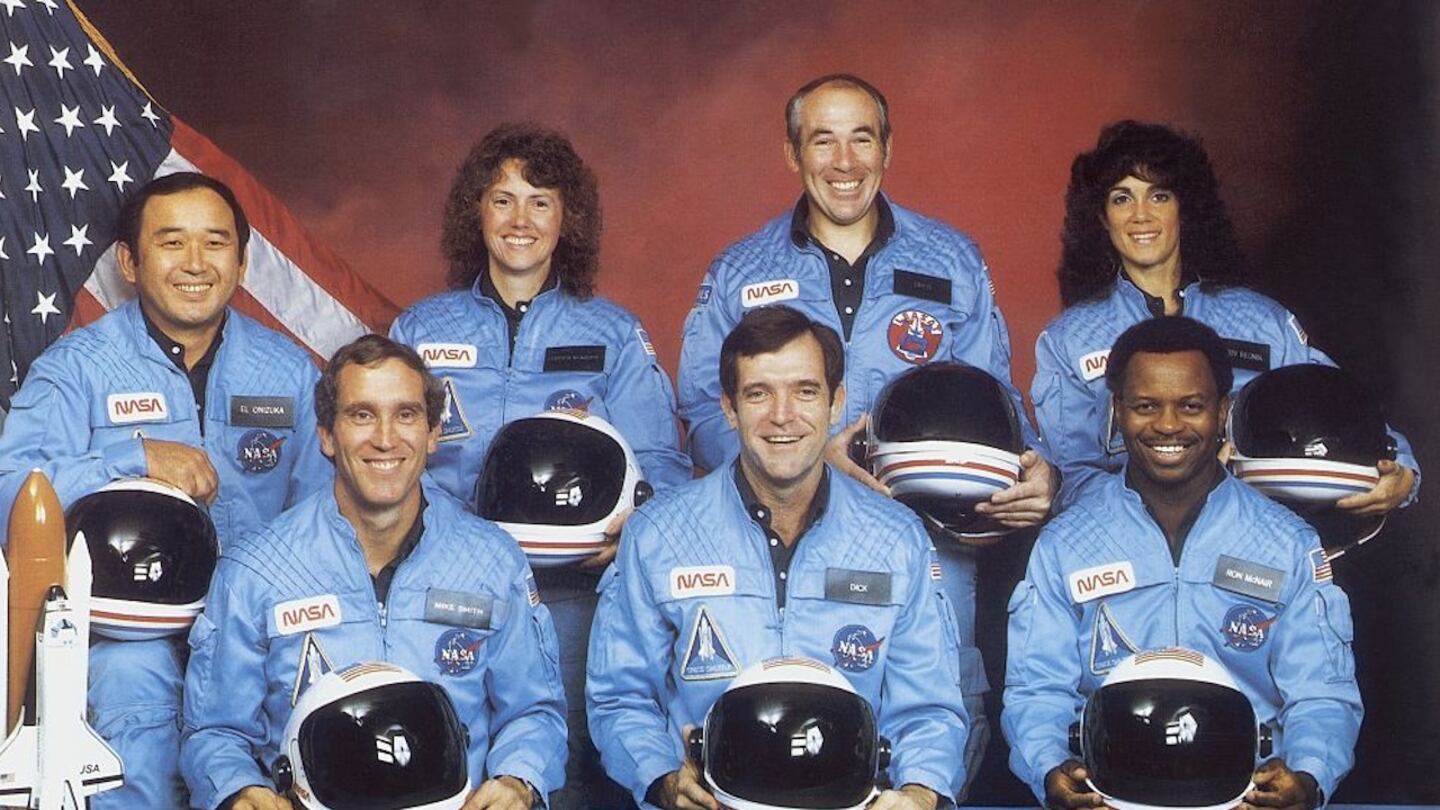
The astronauts who were killed in the 25th launch of a space shuttle included the vessel’s commander, Francis R. “Dick” Scobee; the pilot, Michael J. Smith; mission specialists, Judith A. Resnik, Ronald E. McNair and Ellison S. Onizuka; Gregory B. Jarvis, a payload specialist who worked for the Hughes Aircraft Corp.’s Space and Communications Group in Los Angeles; and New Hampshire high school teacher Christa McAuliffe, who was designated as the “teacher in space.”
Weather and malfunctions had scrubbed the Challenger liftoff five times before Jan. 28. The day before, the flight was scrapped when technicians at the Kennedy Space Center noticed a screw protruding from a door latch and were unable to find a drill to remove it, The Washington Post reported. Even after a hacksaw was used, the Jan. 27 flight was canceled due to high winds.
On Jan. 28, the temperature at liftoff was 36 degrees at ground level approximately 1,000 feet from launch pad 39B, NASA said. The temperature was 15 degrees colder than any previous space shuttle launch.
The predawn temperature was 22 degrees, and liftoff was delayed for two hours, according to the Post.
In an interview with NPR, retired journalist Howard Berkes said that space shuttle flights had become so routine by 1986 that “public interest had waned.”
The launch was not covered by major television broadcast networks that day, and only CNN and NASA’s satellite feed provided live coverage.
Challenger finally blasted off at 11:38 a.m. ET and soared into the Florida sky. It looked like another perfect, mundane launch until 73 seconds had passed. Witnesses began to see a flame move up the side of the vessel’s external fuel tank.
Then there was an explosion as the tank collapsed, and its contents mixed and ignited. The tank was detached violently from the body of the shuttle and spun out of control.
“While traveling at a Mach number of 1.92 at an altitude of 46,000 feet, the Challenger was totally enveloped in the explosive burn,” NASA said.
President Ronald Reagan gave a nationally televised address several hours after the disaster.
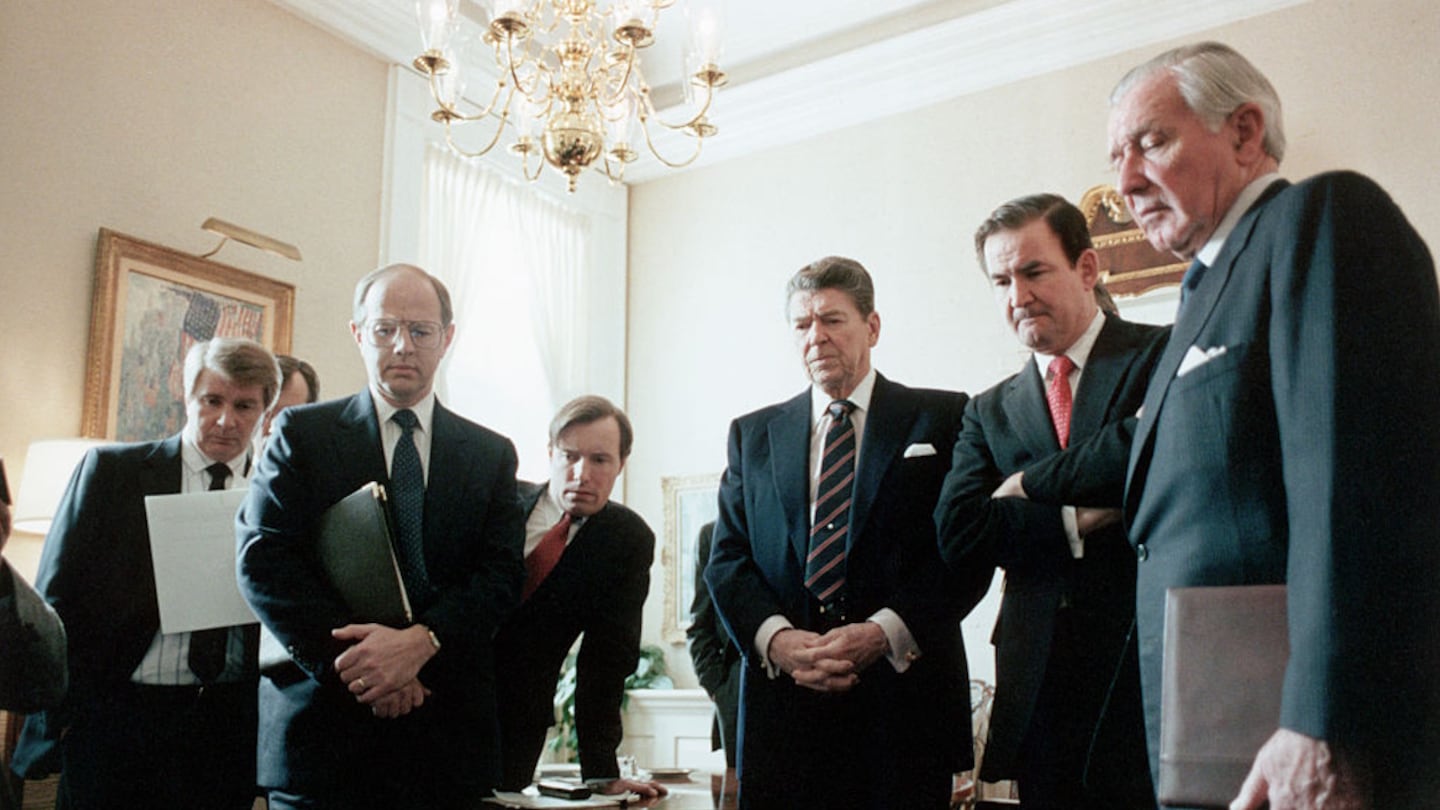
“For the families of the seven, we cannot bear, as you do, the full impact of this tragedy,” Reagan said on a day he was supposed to give his State of the Union address. “But we feel the loss, and we’re thinking about you so very much. Your loved ones were daring and brave, and they had that special grace, that special spirit that says, `Give me a challenge, and I’ll meet it with joy.’
“They had a hunger to explore the universe and discover its truths. They wished to serve, and they did. They served all of us.”
McAuliffe’s father, Ed Corrigan, was angered by NASA’s decision to launch and put his thoughts on paper in a notebook that was discovered by his widow after his death in 1990, the Post reported.
“My daughter Christa McAuliffe was not an astronaut — she did not die for NASA and the space program — she died because of NASA and its egos, marginal decision, ignorance and irresponsibility," Corrigan wrote. “NASA betrayed seven people who deserved to live.”
Last week, NASA held a Day of Remembrance for the Challenger crew and other astronauts who died during missions.
On Jan. 27, 1967, a launch pad fire during program tests for Apollo 1 at Cape Canaveral killed astronauts Virgil “Gus” Grissom, Edward H. White II and Roger B. Chaffee.
On Feb. 1, 2003, there was another space shuttle disaster. The Columbia disintegrated as it re-entered the atmosphere over Texas and Louisiana, killing all seven astronauts -- Rick D. Husband, William C. McCool, Michael P. Anderson, David Brown, Kalpana Chawla, Laurel Blair Salton Clark and Ilan Ramon.
According to NASA, the Columbia orbiter suffered a “catastrophic failure” because of a breach that occurred during the shuttle’s launch. Falling foam from the shuttle’s external tank struck the reinforced carbon panels on the underside of the vessel’s left wing.
At the Kennedy Space Center memorial ceremony, Challenger pilot Michael Smith’s daughter, Alison Smith Balch, said that her life forever changed that morning, according to The Associated Press. “In that sense, we are all part of this story.”
“Every day I miss Mike,” said Smith’s widow, Jane Smith-Holcott. “Every day’s the same.”
© 2025 Cox Media Group