


The state of the U.S. restaurant industry in 2026
Restaurants are proving their durability in 2026.
Each year, Toast polls hundreds of restaurant operators to get a pulse check on the industry. How are restaurants faring in 2026? What are the biggest pain points? Where do they see opportunity, and how has that changed since last year?
What was clear from the 2026 survey from April 3, 2026, to April 20, 2026, of 676 restaurant operators and decision-makers, is that restaurants are durable, and they’re doubling down on being busy and effective to achieve their business goals.
And the data backs it up: 91% of operators rate their business as good or excellent — matching last year's high mark — with growth and efficiency topping their list of priorities.
This is a blind survey of operators and decision-makers with 16 or fewer locations in the United States and includes both Toast and non-Toast customers. Respondents were not informed that Toast was conducting the study.
Key takeaways from the 2026 Voice of the Restaurant Industry Survey:
- Restaurants are durable: 91% of operators rate their business health as good or excellent, unchanged from 2025.
- Inflation (27%) and hiring (22%) are the top two challenges, and both rose more than any other pain point year over year (+7 and +6 points).
- Profitability is the No. 1 goal (37%), and operators are increasingly pursuing it by serving guests in new ways and staying busy, not by cutting.
- AI is now mainstream: 87% of operators feel comfortable using AI, and nearly 9 in 10 are experimenting with it.
- Growth is the plan: bringing in more guests is the top revenue focus.
What's the state of the restaurant industry in 2026?
Restaurant operators are proving remarkably resilient in 2026. Despite rising inflation and hiring difficulties, 91% of operators polled said their business is good or excellent, holding steady with last year's strong showing even as external pressures mounted.
That confidence runs deep: More than 8 in 10 operators feel neutral to extremely comfortable with the current macro climate. Larger operations ($1 million+ GMV) are naturally keeping a closer eye on conditions than smaller ones, but across the board, the overwhelming majority remain steady and optimistic about where their business is headed.
What are restaurants' biggest challenges in 2026?
Among the 676 operators surveyed:
- Inflation: the No. 1 challenge for operators, with 27% ranking it in the top three difficulties for their restaurant in 2026, up 7 points year-over-year.
- Hiring: 22%, the No. 2 challenge, up 6 points year-over-year.
- Guest foot traffic: 15%, no change year-over-year.
- Managing finances: 15%, no change year-over-year.
- Increasing guest throughput: 14%, up 2 points year-over-year.
- Marketing: 14%, down 2 points year-over-year.
- Conducting cost of goods and services (COGS) analysis: 14%, up 2 points year-over-year.
Inflation has been a challenge for many this year, and it’s no surprise that, among surveyed operators, it’s the number one challenge they face in 2026. Hiring the right staff to keep things running smoothly was the next top concern for restaurant operators, and both of these challenges rose significantly in 2026 compared to last year. The remainder of the top challenges remained relatively consistent with last year, with good foot traffic rounding out the top three.

Toast
What are restaurants' top business goals in 2026?
Among the 676 operators surveyed:
- Improve profitability: the No. 1 goal for operators, with 37% of operators ranking it as their top three goals, down 3 points year-over-year.
- Increase guest demand: 30%, up 1 point year-over-year.
- Improve employee productivity: 28%, up 3 points year-over-year.
- Increase the number of ways I generate revenue: 27%, up 6 points year-over-year — the biggest riser.
- Increase same-store revenue: 24%, up 2 points year-over-year.
- Improve employee retention: 22%, down 1 point year-over-year.
- Start using new tech to run the business better: 20%, down 3 points year-over-year.
- Simplify operations: 20%, up 1 point year-over-year.
- Increase guest throughput/turn times: 20%, up 1 point year-over-year
Profitability is the top business goal for restaurant operators in 2026, with 37% of operators ranking it their number one priority, which is in line with the most important goal from last year’s survey.
Also shifting is the way in which restaurants meet that goal of profitability. 30% of operators hope to increase guest demand, and 28% want to improve the productivity of their employees. The biggest jump year-over-year was the goal of increasing the ways restaurants generate revenue, such as adding a new service model, like catering, retail, or online ordering. This signals that restaurants aim to get busier to hit their goals, instead of cutting staff or services to increase their topline.

Toast
Are restaurants hiring in 2026?
Among the 676 operators surveyed:
- Increase staff: 49% of operators polled hope to grow the number of staff they have, down 11 points year-over-year.
- Keep the same number of staff: 48%, up 10 points year-over-year.
- Reduce staff: 3%, up 1 point year-over-year.
- Don't know: 1%.
Restaurants are almost always hiring. But fewer restaurants plan to increase the number of employees they have in 2026 compared to last year. Still, nearly half (49%) of restaurant operators in this survey said they plan to increase staffing levels, compared to 60% in our 2025 survey. A similar number (48%) plan to keep the same number of employees, and just 3% plan on reducing the number of staff they have.

Toast
How are restaurants handling labor challenges?
Among the 676 operators surveyed:
- 51% of operators polled will increase staff efficiency & speed of service should labor challenges increase.
- Increase employee retention strategies: 49%.
- Optimize shift scheduling: 45%.
- Implement technology to reduce staff and guest touchpoints: 35%.
- Purchase hiring software and/or a recruiter: 27%.
- Reduce menu size: 23%.
- Reduce tables available: 20%.
As mentioned earlier, hiring is the number two challenge for restaurants in 2026. So what are they doing to manage the pain if labor challenges increase in the next 12 months? The top strategies are increasing staff efficiency and retaining those great employees. Restaurant operators polled say they are focused on investing in their team and the workflows they use to manage labor, rather than cutting things like the size of the menu or the number of tables available.
*Labor challenges refer to the difficulty in finding and retaining staff at your business, as well as, paying them a competitive wage.

Toast
Which restaurants feel the most economic pressure in 2026?
Among the 676 operators surveyed:
- Larger operators ($1 million+ GMV): extremely comfortable 18%, comfortable 43%, neutral 13%, concerned 22%, extremely concerned 4% with current market conditions.
- Smaller operators (<$1 million GMV): extremely comfortable 25%, comfortable 45%, neutral 18%, concerned 11%, extremely concerned 1% with current market conditions.
Every restaurant is different and faces its own unique challenges, but larger restaurants are more concerned about current market conditions than smaller ones.
26% of restaurants operating with a Gross Merchandise Volume (GMV) of $1 million or more said that they were concerned about the current market conditions, such as inflation, tariffs, the labor market, consumer spending, and the political climate. Meanwhile, that number shrank to just 12% of restaurants operating with a Gross Merchandise Volume (GMV) of less than $1 million.

Toast
How are restaurants responding to inflation and rising food costs?
Among the 676 operators surveyed:
- 43% of operators polled will increase prices on menu items if the cost of goods rises, down 5 points year-over-year.
- Tightly manage/run leaner inventory: 39%, up 12 points year-over-year
- Conduct menu profitability analysis at the item level: 35%, down 3 points year-over-year
- Start tracking the price of key ingredients: 33%, up 4 points year-over-year
- Adjust the number of food suppliers used: 29%, down 2 points year-over-year
Restaurant operators are increasingly looking at more disciplined inventory to keep costs down, while fewer are looking to raise menu prices compared to last year.
Still, 43% of restaurant operators said they will increase menu prices if the cost of goods increases in the next 12 months, but that’s down five points compared to last year.
Operators are increasingly looking at other avenues to control costs. 39% of respondents said they will tightly manage their inventory or manage a leaner inventory in response to rising costs, a 12-point jump from 2025. And 33% of operators polled said they will start tracking the price of key ingredients, a 4-point increase from 2025.

Toast
How comfortable are restaurants using AI in 2026?
Among the 676 operators surveyed:
- 87% of operators polled feel comfortable using AI, up 1 point year-over-year.
- Will use AI more in the future: 85%, up 4 points year-over-year.
- Believe AI will help them be more efficient at work: 81%, no change year-over-year.
- Trust AI with their business needs: 81%, up 2 points year-over-year.
- Say AI tools offer great value for the money: 81%, up 3 points year-over-year.
A lot has changed in the past year when it comes to artificial intelligence. Tools are more powerful, reliable, and integrated into platforms to give better and new insights. Operators are embracing the new tech, but their feelings toward AI are similar to the survey last year.
87% of restaurant operators polled in Toast’s 2026 Voice of the Restaurant Industry Survey say they’re comfortable using AI, which is up one point compared to 2025. And 85% of respondents said they will use more AI in the future, up 4 points compared to last year.

Toast
How are restaurants experimenting with AI?
Among the 676 operators surveyed:
- 19% of operators polled are actively experimenting with AI on their own, but not through vendors: (QSRs 16% · FSRs 23%).
- Actively experimenting with AI through vendors, but not on their own: 42%.
- Experimenting both on their own and through vendors: 25%.
- Considering AI but haven't started: 11%.
- Not considering or using AI: 2%.
Nearly 9 in 10 restaurant operators polled said they are currently experimenting with AI, but how they’re doing so shifts a little bit by segment. Only 19% of operators said they’re experimenting with AI on their own, with that number increasing to 23% for full-service restaurants (FSRs) and just 16% for quick-service restaurants (QSRs). Which makes sense — the more complex the operation, the more areas there are to experiment with, and they may feel more comfortable.
42% of respondents said they were experimenting with AI through one of their tech vendors, and 25% said they’re experimenting both on their own and with their tech vendors.
But just 11% of operators polled said they’re considering AI but haven’t started experimenting, while only 2% of respondents said they aren’t considering the technology or using it at all.

Toast
How are restaurants planning to grow revenue in 2026?
Among the 676 operators surveyed:
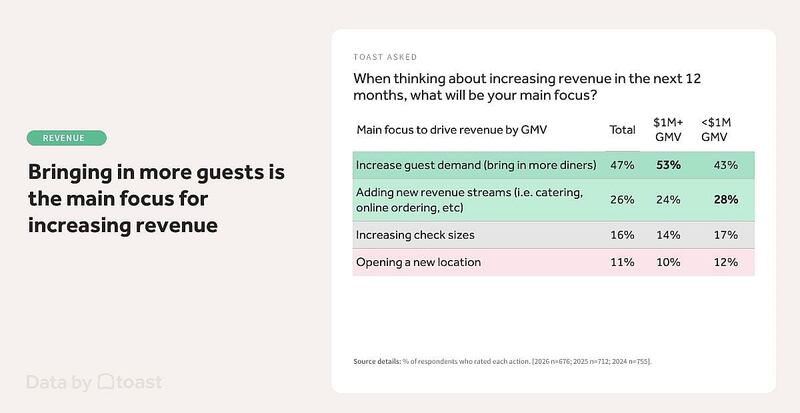
- Increase guest demand (bring in more diners): 47% overall — the top focus for both sizes, at 53% of $1 million+ operators and 43% of <$1 million operators.
- Adding new revenue streams (catering, online ordering, etc.): 26% overall — 24% of $1 million+ operators and 28% of <$1 million operators.
- Increasing check sizes: 16% overall — 14% of $1 million+ operators and 17% of <$1 million operators.
- Opening a new location: 11% overall — 10% of $1 million+ operators and 12% of <$1 million operators.
Busy is the goal, and for the majority of restaurant operators, bringing in more guests to serve is the key to unlocking more revenue.
And that’s more pronounced for larger operations with over $1 million in GMV. 53% of restaurant operators at these restaurants said it was their number one priority to drive more revenue, compared to just 43% of operators whose restaurants bring in less than $1 million in GMV.
Those smaller operators, though, are more focused on adding new revenue streams like catering and online ordering to bring in more revenue.
Toast
The bottom line: durable, efficient, and leaning into growth
The story so far in 2026 is that restaurants are operating with familiar challenges in years past, but they’re leaning into the hard work with a growth mindset. Operators are navigating cost and labor pressures, and are protecting their profitability through efficiency, optimized menus, keeping their teams happy and intact, experimenting with AI, and betting on guest demand.
The challenges at play are familiar for restaurants, and their instinct to turn them into momentum is also something we’ve seen from this durable industry.
DISCLAIMER: This information is provided for general informational purposes only, and publication does not constitute an endorsement. Toast does not warrant the accuracy or completeness of any information, text, graphics, links, or other items contained within this content. Toast does not guarantee you will achieve any specific results if you follow any advice herein. It may be advisable for you to consult with a professional such as a lawyer, accountant, or business advisor for advice specific to your situation.
Frequently asked questions
What are the biggest challenges facing restaurants in 2026?
According to Toast's 2026 Voice of the Restaurant Industry Survey, operators surveyed said that inflation and hiring are the top two, cited by 27% and 22% of operators respectively — and both rose more than any other challenge year over year (+7 and +6 points).
Do restaurants feel profitable and healthy in 2026?
According to Toast's 2026 Voice of the Restaurant Industry Survey, operators surveyed said that confidence is steady: 91% of operators rate their business health as good or excellent, unchanged from 2025, and improving profitability remains the #1 business goal (37%).
Are restaurants hiring in 2026?
Yes. According to Toast's 2026 Voice of the Restaurant Industry Survey, operators surveyed said that 49% plan to increase staff and 48% plan to keep staffing steady over the next 12 months, while only 3% plan reductions. Hiring plans cooled from 2025 (60% planned to increase) but remain healthy.
How are restaurants using AI in 2026?
According to Toast's 2026 Voice of the Restaurant Industry Survey, 87% of operators surveyed feel comfortable using it, 81% say it offers great value for the money, and nearly 9 in 10 are experimenting with AI — most often through the technology vendors they already work with.
How are restaurants dealing with inflation and rising food costs?
Increasingly through cost discipline rather than price hikes: 43% of operators polled in the 2026 Voice of the Restaurant Industry Survey would raise menu prices (down 5 points), while tighter inventory management jumped 12 points to 39%, and roughly a third are conducting item-level menu profitability analysis or tracking key ingredient prices.
How are restaurants planning to grow in 2026?
By bringing in more guests. According to Toast's 2026 Voice of the Restaurant Industry Survey, operators surveyed said increasing guest demand is the top revenue focus for both larger (53%) and smaller (43%) operators, with smaller restaurants also leaning into new revenue streams like catering and online ordering (28%).
Methodology
2026 Survey Methodology
To help better understand the restaurant industry, Toast conducted a blind survey of 676 restaurant decision-makers operating 16 or fewer locations in the United States, including both Toast and non-Toast customers, from April 3, 2026, to April 20, 2026. Respondents include a mix of both full-service and quick-service restaurants. Respondents were not made aware that Toast was fielding the study. Panel providers granted incentives to restaurant respondents for participation. Using a standard margin of error calculation, at a confidence interval of 95%, the margin of error of +/- 4%.
2025 Survey Methodology
To help better understand the restaurant industry, Toast conducted a blind survey of 712 restaurant decision-makers operating 16 or fewer locations in the United States, including both Toast and non-Toast customers, from April 18, 2025, and May 13, 2025. Respondents include a mix of both full-service and quick-service restaurants. Respondents were not made aware that Toast was fielding the study. Panel providers granted incentives to restaurant respondents for participation. Using a standard margin of error calculation, at a confidence interval of 95%, the margin of error of +/- 4%.
2024 Survey Methodology
To help better understand the restaurant industry, Toast conducted a blind survey of 755 restaurant decision-makers operating 16 or fewer locations in the United States including both Toast and non-Toast customers from May 17, 2024 to June 2, 2024. Respondents include a mix of both full-service and quick-service restaurants. Respondents were not made aware that Toast was fielding the study. Panel providers granted incentives to restaurant respondents for participation. Using a standard margin of error calculation, at a confidence interval of 95%, the margin of error on average is +/- 4%.
This story was produced by Toast and reviewed and distributed by Stacker.