


Americans with open student loan debt are navigating the biggest changes to federal repayment programs in years. For many, the developments are unsettling.
Among other shifts, the popular SAVE repayment plan was discontinued, requiring millions to move to new plans with potentially burdensome payments heading into 2027.
Below, Intuit Credit Karma looks at what's happening with student loans in 2026.
Top findings from the report
Here’s what stands out from Credit Karma’s analysis of TransUnion data for 24.2 million members with open student loan debt at the end of the third quarter of 2026.
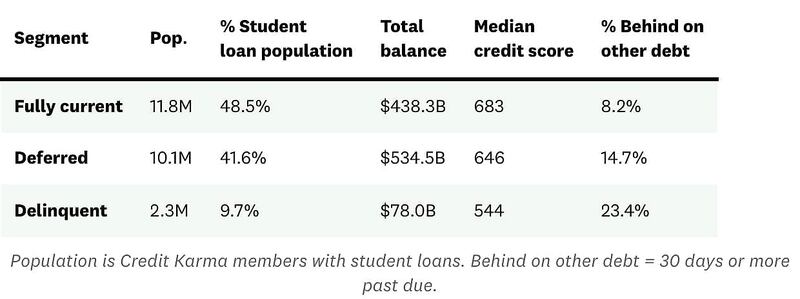
1. Borrowers with loans in deferment — some 10.1 million Credit Karma members with student loans — appear financially vulnerable, as many face restarting loan payments heading into 2027.
- 14.7% are behind on other debt vs. 8.2% of those fully current and actively repaying their loans
- Median credit score for the deferred population is 37 points lower than the fully current group's (646 vs. 683)
2. Those with the smallest student loan balances are actually the most likely to be delinquent.
- Student loan borrowers with less than $10,000 in debt — the lowest debt band — have the highest delinquency rate.
- This aligns with broader consumer debt patterns. Most bills that end up in collections are smaller-dollar credit card, phone and utility balances.
3. Gen Z and millennials together make up nearly three-quarters of borrowers with student loans, but Gen X is struggling with delinquency at a slightly higher rate than its younger peers.
- The Gen X student loan delinquency rate is 10.4% of members vs. 9.7% for millennials and 9.6% for Gen Z.
- Gen Z has the highest share of members with loans in deferment, as expected given their life stage.
The Credit Karma student loan population: 2026 snapshot
Credit Karma has 24.2 million members with open student loans totaling more than $1 trillion in debt.
About 95% of their loans are federal (as opposed to private loans). For scale, Federal Student Aid counts about 42.3 million federal student loan borrowers nationwide.

Intuit Credit Karma
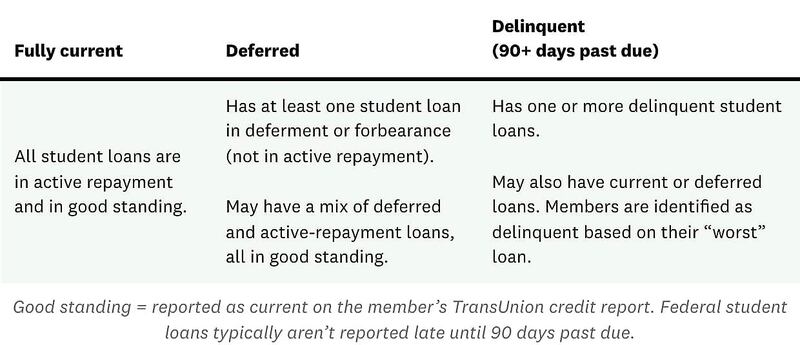
To better understand the student loan population, Credit Karma separates its members into three segments for analysis, based on the status of their student loans.
Population segments
Intuit Credit Karma
How many student loan borrowers are fully current, deferred or delinquent?
Heading into the last quarter of 2026, more than 48% of all Credit Karma members with student loans were fully current on all of their student loans, while close to 10% were delinquent.
Another large share — more than 41% — had at least one student loan in deferment.
Intuit Credit Karma
Borrowers with deferred loans show more signs of financial strain than borrowers who are paying on all their loans, with a much lower median credit score and a greater share behind on other debt.
The smaller group with delinquent student loans is under the most pressure, with nearly a quarter struggling with other debts.
This breakdown is particularly relevant heading into 2027 because, as former SAVE borrowers begin new plans, a large share of the deferred population may shift to fully current in the near term. In the longer term, the delinquent group could grow.
It’s unclear how many Credit Karma members were on SAVE, but the U.S. Department of Education estimated 7.5 million borrowers nationally were on the plan.
Student loan data: Generations
Younger generations generally tend to have lower balances and a greater share in deferment. One likely reason: They’ve had less time to accumulate student loan debt, and fewer of them have started repayment.
The following table details the percentage of each generation that’s fully current, deferred or delinquent on their student loans, along with their total and median balances and median credit scores.

Intuit Credit Karma
Which generations are struggling the most with student loan delinquency?
This table breaks down student loan delinquency totals by generation, showing how many of each generation’s borrowers are delinquent — and the share that are 90 to 269 days past due (severe delinquency) or 270 or more days past due (default).
Severity of student loan delinquency by generation

Intuit Credit Karma
Federal loan servicers generally don’t report late accounts to the credit bureaus until 90 days past due. At that point, a late mark can land on your credit report and stay there for up to seven years. At 270 days past due, a federal student loan goes into default. If it’s unresolved past 360 days, the government can garnish wages or take other collection action, like seizing your tax refund.
Typical Gen Z with student loan debt
Gen Z makes up about a quarter of Credit Karma members with student loans. They carry smaller typical balances than millennials, Gen X or boomers, along with the highest rate of deferment of any generation, which is reasonable given their life stage.
The following table breaks down Credit Karma’s Gen Z population with open student loans, segmented by loan status and revealing the average and typical credit scores, plus the median balance carried per borrower.

Intuit Credit Karma
The following table shows how Gen Z members with student loans are handling other types of debt.
Consistent with the broader student loan population, the group with deferred student loans is more strained by other debt, including personal loans and credit cards, than the overall population of Gen Z with student loans.
Gen Z student loan borrowers behind on other debt

Intuit Credit Karma
Typical millennial with student loan debt
Millennials make up about half of Credit Karma members with student loans, and most are now in their 30s or early 40s.
The following table breaks down Credit Karma’s millennial population with open student loans, segmented by loan status and revealing the average and typical credit scores, plus the median balance carried per borrower.

Intuit Credit Karma
Like Gen Z and the rest of Credit Karma’s student loan population, millennials whose loans are in deferment fall behind on other debt more often than millennial student loan borrowers as a whole.
It’s notable that mortgage and auto payment delinquency is a bigger factor for millennials than it is for their younger peers.
Millennial student loan borrowers behind on other debt

Intuit Credit Karma
Student loan data: Debt loads and delinquency
The following table shows that the highest rates of student loan delinquency belong to the two lowest debt bands.

Intuit Credit Karma
This may seem counterintuitive, but a Brookings Institution student loans study found that the smallest balances often belong to people who left school early, and that lower earnings were a key factor in their default rates. The takeaway: Falling behind often has more to do with a person's financial footing than with how much they owe.
Other types of consumer debt follow a similar pattern — most debts that end up in collections are small. In 2026, the typical non-medical debt in collections on Credit Karma members’ credit reports was under $700, mostly from credit cards and basic bills like utilities and phone service. Small unpaid bills like these can reflect a tight budget, where even routine costs are hard to cover.
Student loan data: Credit cards and other debt
The following table compares how often borrowers in each student loan group fall behind on other debts, like credit cards and loans, with how often members without student loan debt do.

Intuit Credit Karma
Even with student loans paused, the deferred group falls behind on other debt more often than members without student loan debt.
Notably, the fully current group looks the healthiest — even more so than those whose debt does not include student loans.
Student loan data: Credit scores
As a group, student loan borrowers have average and median credit scores that are noticeably lower than those whose debt doesn’t include student loans.
But if you isolate the scores of those who are fully current and actively repaying their student loans, it’s a different picture: This subset has a better average score than those without student loans, and a neck-and-neck median score.

Intuit Credit Karma
Student loan data: Score bands
Score bands can only tell you so much when it comes to delinquency rates, because falling behind on a credit account lowers your credit score.
But the following table of data can shed some light on how much trouble student loan borrowers with lower scores are having with other types of debt, such as credit cards or loans (including personal, auto and home).

Intuit Credit Karma
Methodology: Credit Karma student loan data
This report draws on the TransUnion credit reports of 24.2 million Credit Karma members with open student loans as of Sept. 30, 2026. Credit Karma counts open accounts that TransUnion classifies as student loans, no matter who reports them. Generations are based on birth year (Gen Z: 1997 and later; millennials: 1981–1996; Gen X: 1965–1980; baby boomers: 1946–1964; Silent Generation and older: before 1946). Each member is grouped (fully current, deferred, or delinquent) by their loan in the worst shape: Fully current has all loans in active repayment and in good standing; deferred has at least one loan in deferment or forbearance and none reported past due — may also have current loans; and delinquent has at least one loan 90 or more days past due; may have other loans in good standing or deferred, but they land in the delinquent category only, based on their worst loan. Members whose worst student loan was reported 30-89 days past due (less than 1%) aren’t included in any segment, so percentages may not add to 100%. Credit scores are VantageScore 3.0 as of early October 2026; members without a score are left out of the score figures. “Behind” on other debt means at least 30 days past due. Members without student loan debt have at least one open credit account but no student loans. Collections figures cover non-medical accounts in collections on members’ TransUnion credit reports.
FAQs about student loan debt
What is the typical student loan debt?
Among Credit Karma’s 24.2 million members with student loans, the median total balance was about $23,000 as of September 2026. That aligns with the Federal Reserve’s most recent Survey of Consumer Finances, which found a median balance of about $24,500 among families with student debt in 2022.
How can delinquent student loans affect your credit score?
Loan servicers typically don't report late federal student loan payments until 90 days past due. But once that happens, your scores can take a hit just as they would with other credit accounts. If you're worried, review student loan resources or consider reaching out to the nonprofit TISLA for free student loan advice.
How can I get forgiveness on a student loan?
One major federal path to student loan forgiveness is Public Service Loan Forgiveness (PSLF), which may be an option for those working full-time for an eligible government agency or nonprofit. PSLF can forgive the remaining balance on federal Direct Loans after 120 qualifying monthly payments. You can check details at Federal Student Aid's forgiveness page.
What is the Standard Repayment Plan for federal student loans?
The Standard Repayment Plan splits your balance into fixed monthly payments for up to 10 years, or 10 to 30 years for consolidation loans. If you don't pick a repayment plan, your servicer will put you on this one. This plan tends to have higher monthly payments (but less total interest to pay). Federal Student Aid can help you compare student loan repayment plans.
What’s the difference between a delinquent and a defaulted federal student loan?
A federal student loan is considered delinquent as soon as you miss a payment, but servicers typically don't report it as late to the credit bureaus until it's 90 days past due. Once they do report it, it can hurt your credit. After 270 days past due, the loan goes into default, which can eventually trigger wage garnishment and the seizure of tax refunds.
This story was produced by Intuit Credit Karma and reviewed and distributed by Stacker.